
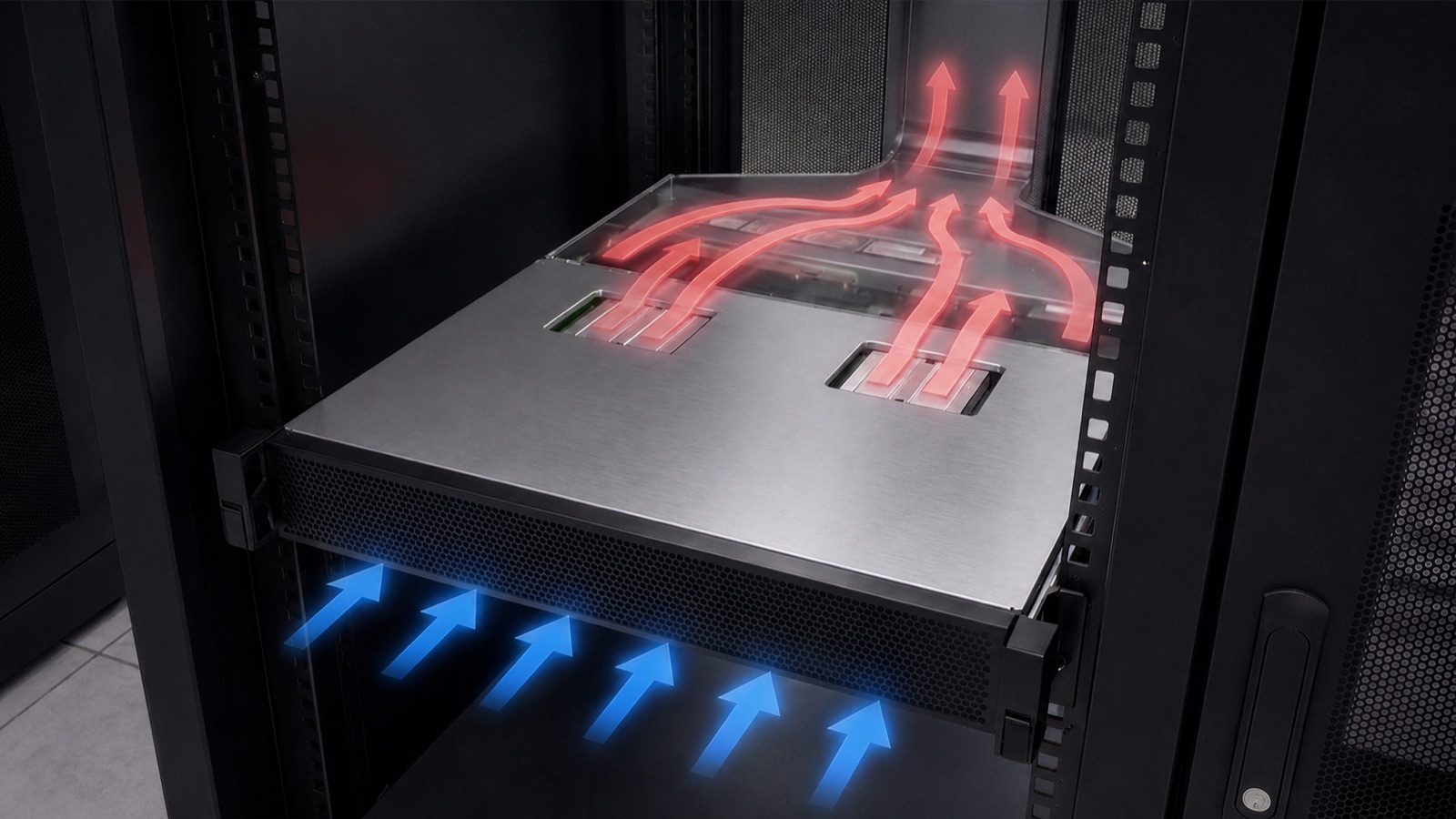
We think the assumption deserves more scrutiny than it usually gets.
Liquid cooling works, and at very high densities it will keep being the right answer. But choosing it is not really a cooling decision. It is a facility decision. Cold plates, pumps, CDUs, manifolds and hoses. New service procedures. Water brought into the white space, with the leak risk that comes with it. Retrofit cycles measured in quarters rather than weeks. Plenty of teams take all of that on by default rather than by choice.
The question we have been working on is a different one. How much power can air actually remove if you change the way it meets the hot surface?
Conventional heat sinks are capped by the boundary layer, the slow-moving film of air that forms against a fin and insulates it. Adding fin area and airflow pushes against that limit without removing it. JouleForce™ changes the geometry so the boundary layer never fully forms, and heat leaves along the entire length of each micro-channel rather than only where fast-moving air happens to touch a surface.
That opens a third path. Not conventional air and not liquid at the chip. Air cooling extended far enough to carry loads that currently force a facility-level decision.
What that buys an operator is specific. No water, no CDUs or manifolds to install. A short rack-level retrofit rather than a building project. And less airflow than the conventional baseline, not more.
Liquid will still have its place. The argument is about where the line sits, not whether the line exists.